Showing posts with label gallica rose. Show all posts

10 July 2011

Rosa gallica "Versicolor" - rosa mundi or Fair Rosamund's rose


This ancient striped gallica, "Versicolor", known from well before 1600, is clearly a striped sport of the even more ancient gallica variety "Officinalis".

Versicolor is even lower growing than Officinalis and makes a wonderful clipped border hedge (as at Hidcote) and often reverts to Officinalis.

Tradition has it that Officinalis (the Provins rose) was brought back from the Barons Crusade (1239-1241) by King Theobald I of Navarre to his castle at Provins near Paris in 1240. Tradition also has it that he carried it all the way from Damascus in his helmet.

No one knows exactly where or when the striped form arose but it must have been after this.

What of the curious name "rosa mundi"? The Latin literally means rose of the world (i.e. with the world's impurities) as opposed to the Latin "rosa munda" meaning "pure rose". The name therefore alludes to the impurity of its colouring being splashed red and white.

This play on words is said to have been the epitaph on the tomb (now lost) of Fair Rosamund, the mistress of Henry II, who was eventually banished to a nunnery for her impropriety.

Hic jacet in tumba Rosamundi non Rosamunda, Non redolet sed olet, quae redolere solet.
(Here lies entombed a worldly rose, not a rose that's pure; she who used to smell so sweet, now smells but not so sweetly)

White splashed with crimson indeed.

Rosa gallica "Officinalis" - the Apothecary Rose


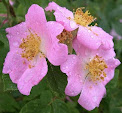
Rose gallica is a European wild rose, a small shrub (usually less that 4 ft) and by convention considered red (actually more a deep reddish pink). A semi-double form "Officinalis" (see photograph, left) is one of the earliest recoded cultivated roses. It has many names, for instance: "The Provins Rose" (after the beautiful medieval town of Provins just outside Paris), or simply "The Red Rose". It is also the rose with the best claim to being the "Red Rose of Lancaster", the symbol of one of the warring factions in the wars of the roses.

The semi-double form is said to have originated in Damascus and been taken from thence by the crusader King Theobald in 1240 - taken back to his castle at Provins hence the name "Provins rose".

It has a fruity (rather than musky) scent, similar to the scent of Rosa damascena, and is a lovely garden plant. Its small size means that it can easily be used in flower borders and even to edge them, as it can be clipped into a lax low hedge. In Hidcote garden in England the striped form "Versicolor" has been used like this - to fabulous effect.

During the 19th century it spawned many sports and hybrids. The best of these (and all are my favourites!) are: "Belle de Crécy", "Cardinal de Richelieu" "Charles de Mills" and "Tuscany Superb". However, there is much to be said for the true original Apothecary Rose, and even for the wild single red rose. In Miss Jekyll's time the gallica roses were considered dépassé. She wrote about them only briefly in her chapter on the "Old Garden Roses":

"[The rose] Provins is Rosa gallica, the garden kinds being mostly striped; pretty, but not of the first importance..."

Being such an ancient variety, it became firmly embedded in medieval European culture. The red rose (Rosa gallica) and the lily (Lilium candidum) are described by the monk Walafrid Strabo (808 - 849 CE) in his poem "Hortulus". He makes it clear that the red of Rosa gallica had entered into Christian iconography as symbolizing the blood of the martyrs.

"These two flowers, well loved and honoured far and wide
Down many centuries have stood as emblems
Of the greatest treasures of the Church - the Rose plucked
As a sign of the blood shed by the blessed martyrs;
The Lily worn as a shining symbol of faith."

Similarly, when Hubert van Eyck (c. 1385 – 1426) set out to paint the great altarpiece at Ghent ("The Adoration of the Lamb"), his panel depicting the male martyrs has them standing by a red rose, using the same symbolism described by Strabo. It is commonly assumed that the red rose was also a symbol of Christ's passion. Actually there is little evidence of this. The standard symbol of the Passion during the Middle Ages was the heraldic pelican - pecking its breast to feed its young with its own blood.

The name "Apothecary rose" signifies correctly that this was by far the most important rose in ancient medicine. Nicholas Culpeper (1616 - 1654) in his Complete Herbal, always quick to criticise his contemporaries, says (mischievously):
"What a pother have authors made with roses! What a racket have they kept? I shall add, red Roses [Rosa gallica] are under Jupiter, Damask [R. damascena] under Venus, White [R. alba] under the moon and Provence [R. centifolia] under the King of France."

18 June 2011

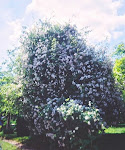
Rosa alba "Semiplena"


Rosa alba, the White Rose of York is an ancient rose, much loved by Miss Jekyll. It was chosen by the Yorkists for their emblem, against Rosa gallica (or possibly Rosa damascena), the red rose of Lancaster. It is a lovely scented white single rose with attractive greyish foliage.

The story every English schoolchild learns is that sometime around 1450 Richard Plantagenet (Yorkist) and the Earl of Somerset (Lancastrian) met with other nobles in the Temple Garden in London to debate allegiance. Growing in the Temple garden was a bed of roses, white and red. As Shakespeare tells it:

Plantagenet: Since you are tongue-tied and so loath to speak,
In dumb significants proclaim your thoughts:
Let him that is a true-born gentleman
And stands upon the honour of his birth,
If he suppose that I have pleaded truth,
From off this brier pluck a white rose with me.

Somerset: Let him that is no coward nor no flatterer,
But dare maintain the party of the truth,
Pluck a red rose from off this thorn with me.

The Temple Garden still exists as part of the Inns of Court in London. The name comes from the fact that it was the precinct of the Knights Templar in the 12th century, later passing into the hands of the Knights Hospitaller. The Halls became infested with lawyers in the 14th century, who found the site agreeable and never left.

Of course the Rosa alba picked by Richard may have been the fully double Rosa alba "Maxima", but the the semi-double variety Rosa alba "Semiplena", which is illustrated in the photograph here, is probably older. This has the best claim to be the Yorkists' rose.

Rosa gallica "Officinalis" and Rosa alba "Semiplena" are lovely together just as they were in the Temple garden in 1450. The taller Rosa alba should be in the middle and the gallicas planted around the outside - the result is the purest expression of the rose - that quintessence that entered into western culture in the high Middle Ages and, like the lawyers, never left.