Showing posts with label rose propagation. Show all posts

23 April 2010

Propagation of Roses by cuttings


Chapter 19 (extract 2) of "Roses for English Gardens" by Jekyll and Mawley (1902), in which Mr Mawley describes propagation of roses by cuttings, the method of propagation favoured by amateurs.
---
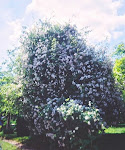
Illustration: Cluster rose on its own roots (propagated by cutting)
---
Raising Rose Plants from Cuttings.—Now that excellent Rose plants can be obtained ready made, as it were, from the nurseries at such reasonable prices, it seems hardly worth while trying to raise them from cuttings, besides which, budding is a much more certain and quicker method of increasing a stock of Roses. To ensure the greatest measure of success the following directions may be followed with confidence, as they are the outcome of the experience of one of the most skilful raisers of own-root Roses that we have ever had. A cucumber or other cold frame should be placed on hard ground and filled with a mixture of loam, sand and leaf-mould in nearly equal proportions to the depth of six inches. This compost should be made very firm and afterwards well watered. In a few days it will be ready to receive the cuttings.

The best time to commence operations is towards the end of September. The cuttings should be taken from shoots which have borne the first crop of Roses of the year, as they will then be in the half-ripened condition required. They should not be cut from the plant but stripped off with a slight heel. The cuttings should be about four inches in length and thus prepared. All the leaves should be cut off except the two lower leaflets of the two upper leaves. They must be dibbled in and made very firm at the base or they will not strike. The cuttings should be inserted six inches apart and three inches deep, leaving the remaining inch with its leaflets to peep out above the compost. After the cuttings have been planted they should for a time be kept close, admitting a little air to prevent the leaflets damping off. In severe weather the frame must be covered with sufficient matting or other material to keep out frost, or the cuttings will be lifted by its action on the compost and so prevented from rooting. Early in May in the following year they should be taken up with a ball and potted, kept close for a time in a frame, and then gradually exposed to the air and sunshine. In August they will be ready to plant out. The Roses which best answer to this treatment are the stronger growing varieties, for the moderate growers, if they succeed at all, take a long time before they make good plants.

Rose cuttings may be struck in the open ground under a north wall or other shady spot, planting them in sandy soil as above advised; but owing to the disturbing influence of frost and other causes the percentage of successes will not be nearly so great as when they are afforded the protection of frames.

Grafting.—This method of propagation is scarcely ever employed by amateurs, and it is therefore unnecessary to describe it here. It is used by nurserymen, principally for raising pot Roses and as a rapid way of increasing the stock of any new or rare variety.

More:

Propagation of Roses by budding


Chapter 19 (extract 1) of "Roses for English Gardens" by Jekyll and Mawley (1902), in which Mr Mawley describes the process of budding, by which most new plants are still made in the horticultural trade.
---
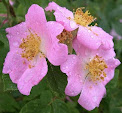
Illustration: Rose Viscountess Folkestone (Hybrid Tea)
---

Budding Standard Stocks.—Budding is one of those things which cannot readily be learnt from printed instructions, but which any proficient in the art will be able to teach the beginner in a few lessons, and which a little practice afterwards will soon render quite easy to him. A few hints may, however, be useful when the mechanical process has been mastered. For instance, in budding standard stocks a single rather long slit is preferable to the somewhat shorter T-shaped one usually employed, as the transverse cut weakens the shoot of the Brier and often causes it to snap off in high winds where it has been made. It is also a good plan to give the roots of the stocks a good drenching with water before they are budded, as it will cause the bark to come away from the wood more readily than it otherwise would have done.

Budding can be done at any time during the summer; the early part of July is usually the best period of the year to begin, as the majority of the shoots are then in that half-ripened condition which is so desirable— that is to say, neither too sappy nor on the other hand too old and dry. The shoots of the Rose from which the buds are taken should be in the same half-ripened condition, and the buds themselves only moderately plump and consequently quite dormant.

If the bark does not come away readily from any shoot when the handle of the budding knife is inserted, it is useless to try and bud on it. When the prickles on either the shoot of the Brier to be budded or on the shoot of the Rose from which the bud is to be taken come off easily and there are at the same time fresh green leaves at the end of that shoot, it is certain to be in the best condition possible for budding. The Hybrid Perpetuals and Hybrid Teas will be found easier to bud than the Teas. The buds should be tied in moderately firmly but not too tightly. In a fortnight's time they may be tied afresh, this time more loosely. After budding, none of the budded shoots of the Brier should be touched with the knife until November, when the longest and most vigorous may be shortened about one-third of their length.

Budding Dwarf Stocks.—The stocks should be kept well earthed up until budding time, when the surrounding soil should be removed with a small hand fork from a few of the Briers as they are wanted. The main stem should then be cleaned with a rag and the slit made in it for the insertion of the bud.

The T-shaped slit, previously objected to in the case of standard stocks, may here be made, and a single bud (or if preferred two buds close together) be inserted in it. The buds should be inserted quite low down in the stem near the roots and not in the upper part of it. The instructions given when treating of budding standard stocks as regards watering, the time of year, the selecting of the buds, and also as to tying and retying them after insertion, apply equally to those dwarf stocks.
----
More: