Showing posts with label Scotch briars. Show all posts

20 April 2010

The brier roses - Origin of the Scotch briars; the Stanwell Perpetual

Chapter 3 (extract 3) of "Roses for English Gardens" by Jekyll and Mawley (1902), in which Miss Jekyll describes the origin of the Scotch brier and notes the strengths and weaknesses of the Stanwell Perpetual.
---
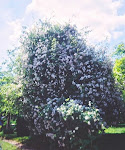
Illustration: Burnet rose on a rough garden bank
---
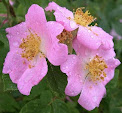
The Scotch Briers are derived from the native Burnet Rose (R. spinosissima), and are amongst the hardiest and most accommodating of their race. Even in the poorest soils they will grow freely if only they are given a little nutritive encouragement in their first year; after that they take care of themselves. The Burnet Rose is found in many parts of England and Scotland, generally in heathy places not very far from the sea. Among its many merits the beauty of its large, round, black hips should not be forgotten. These are like exaggerated black currants, only more flattened at the poles, with a diameter of from half to three-quarters of an inch.

There is a useful Rose, a hybrid of these Briers, that should be grown with them, called Stanwell Perpetual. It fully deserves its name, as it flowers throughout the summer. Its weak point is a somewhat straggly habit. To correct this it is well to place three plants in one group close together — that is to say, about a foot apart — when they will close up and form a well-shaped bush.

The brier roses - Use of the Scotch Briers

Chapter 3 (extract 2) of "Roses for English Gardens" by Jekyll and Mawley (1902), in which Miss Jekyll discusses the role within garden design of the Scotch Briers.

---
By the first week of June the Scotch Briers are in flower, in all their pretty colourings of pink and rose and pale yellow, besides the strongest growing of all, the double white. Those who are interested in this class of Rose should inquire in the good old Scotch gardens, where no doubt fine forms still exist that have not come into trade. One of the best and quite the sweetest has become rare, and sometimes cannot be had even in the best Rose nurseries. It is of a pale pink colour, and is conspicuous among other kinds for remaining some time in a globular or half-opened shape. The leaves are of a bluish tint, and the scent is stronger and sweeter than that of any other.

The Scotch Briers are excellent plants for many kinds of use, but are perhaps best of all in wild banks with Heaths and Cistuses. No bushy thing is better for the capping of a dry wall, for it will hang over and also throw out runners between the stones and show itself off quite at its best. These fine hardy Briers have also one merit that most Roses lack, for in winter the leafless crowd of close-growing, plentifully-prickled branches forms masses of warm bronze colouring that have quite a comforting appearance. The pretty Briers might well replace the dull and generally ugly steep slopes of turf that disfigure so many gardens. They are charming accompaniments to steps and their low balustrades; they are equally in place in the humblest garden and the most exalted, and in all sorts and kinds of places and for all kinds of uses they hardly ever come amiss.

They are also distinctly in place crowning the upper portions of bold rockwork; in fact this way of having them is one of the very best, for they love free air and unstinted light, and their neat bushy forms and crowded wreaths of bloom are never seen to better advantage than when viewed a little from below.